ART EMOTION FLOW
Konstantin Korovin and the Comfort of the Night: An AEF Analysis
By admin2026. 2. 18.
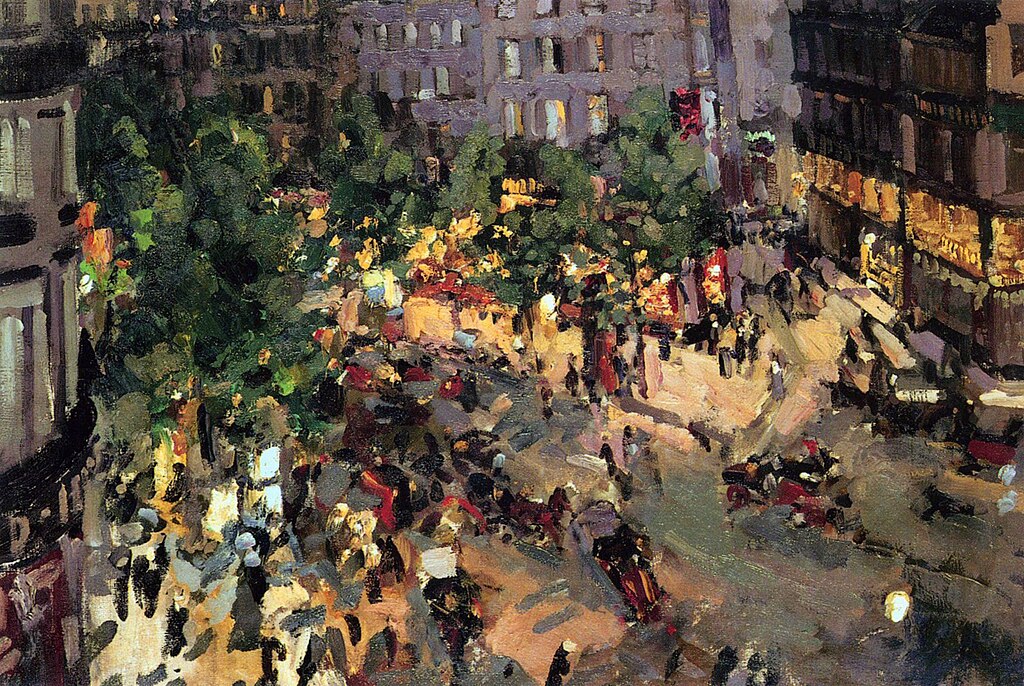
Konstantin Korovin and the Comfort of the Night
An Art Emotion Flow (AEF) Analysis
Konstantin Korovin’s <Boulevard des Capucines (1911)> acts as an "emotional guide," leading our nervous system into its most secure and tranquil state through the contrast between nocturnal darkness and the gentle glow of vintage streetlamps.
| AEF Pillar | Neuro-Mechanism & Effect |
|---|---|
|
1. Cognitive Noise Reduction Selective Information Processing |
Mechanism: By erasing unnecessary visual "noise" through darkness, the brain reduces energy consumption in the visual cortex. This "Cognitive Ease" provides immediate rest for the exhausted frontal lobes. |
|
2. Low-Saturation Light The Low-Kelvin Effect |
Thermal Resonance: The warm, orange glow of era-specific carbon lamps (approx. 2,000K) penetrates the retina without strain. The brain interprets this as the "warmth of a campfire," triggering a Psychological Safety mechanism. |
|
3. The "Inhale Flow" Soft Contrast & Grounding |
Mirror Neuron Activation: Loose brushwork blurs boundaries, allowing the brain to accept the landscape as a singular "mood" rather than a set of shapes. This synchronizes the viewer with the city's stillness, creating a deep sense of Grounding. |
"Unlike the exhausting vitality of daylight, Korovin’s night-time light shifts the brain from a state of external consumption to internal restoration, offering a romantic sanctuary for the modern mind."