ART EMOTION FLOW
Ilya Repin’s On a Turf Bench (1876): The Aura of Time—Moving Beyond Realism into Energy
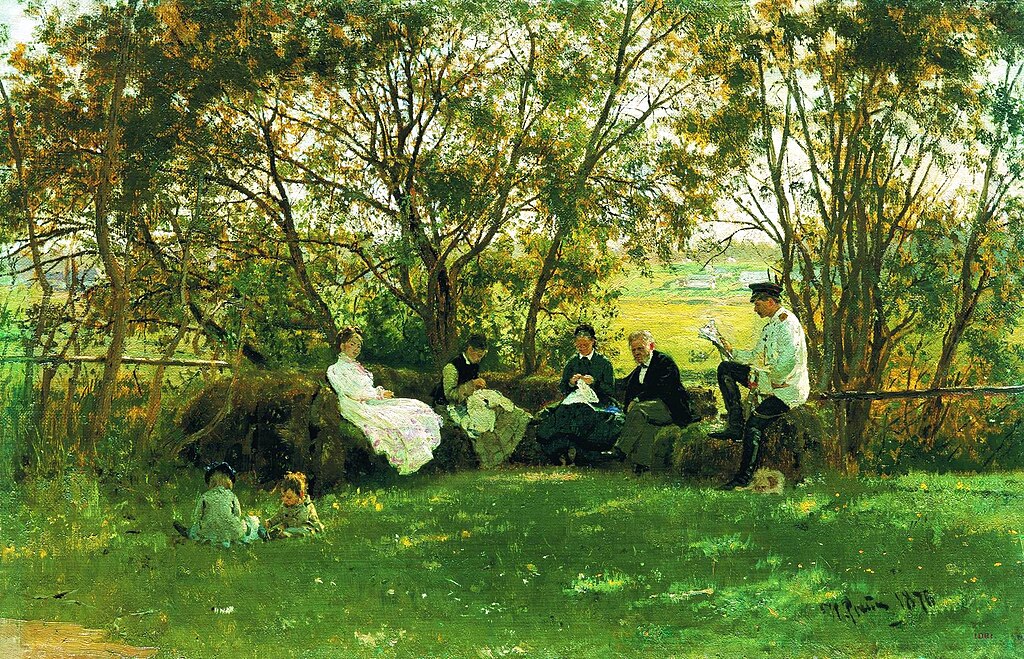
Why do we experience a profound "aura" before a realist masterpiece? It is because the artwork is not merely a "replica of reality," but a vessel for accumulated time.
While photography records reality, Repin’s paintings reconstruct the "physiological energy" and "sensory density" flowing within it. This analysis is not art-historical in the conventional sense; it is an emotional transfer perspective, focusing on how the viewer’s nervous system absorbs and synchronizes with the energy embedded in the work.
1. The Aura of Labor (Aura: The Breath of Effort)
In Realism, aura stems from the density of human labor. When a painter observes a single leaf for hundreds of hours, that "intense gaze" permeates the pigment. The aura is not just visual detail—it is the invisible residue of time and attention.
2. Kinetic Energy of the Brush (Energy: The Pulse of Life)
A photograph is a static chemical reaction; a painting is a record of kinetic energy. Every brushstroke is a pulse from the artist’s nervous system. The viewer does not simply see pigment—they decode the rhythm of human movement.
3. Contextual Synchronization (Emotional Synchronization)
Contextual connection means the viewer synchronizes with the artist’s biological time. Standing before Repin’s work, we experience his immersion in the subject. This is not just visual recognition but a frequency match between artist and viewer.
4. How This Differs from Traditional Analysis
Traditional art-historical analysis emphasizes biography, style, iconography, and socio-political context. It asks: What does the painting represent? How does it fit into history? Emotional transfer analysis asks instead: What does the painting do to my body and mind right now?
Where conventional methods highlight external meaning, AEF highlights internal resonance. It treats aura as a physiological and emotional phenomenon, not just a cultural construct. This shift is crucial in the AI era, where information itself becomes aura—contextual knowledge acts as emotional fuel, altering how we feel before the work.
5. Comparative View: Conventional vs. Emotional Transfer
| Aspect | Conventional Analysis | Emotional Transfer (AEF) |
|---|---|---|
| Focus | Historical context, iconography, technique | Physiological energy, emotional synchronization |
| Value Source | Cultural meaning, symbolic interpretation | Aura of labor, kinetic brush energy |
| Viewer Role | Detached interpreter | Immersed participant |
| Outcome | Knowledge acquisition | Emotional recovery, resonance |