ART EMOTION FLOW
<Rainy Day, Boston> – The Golden Ratio of Information and Emotion
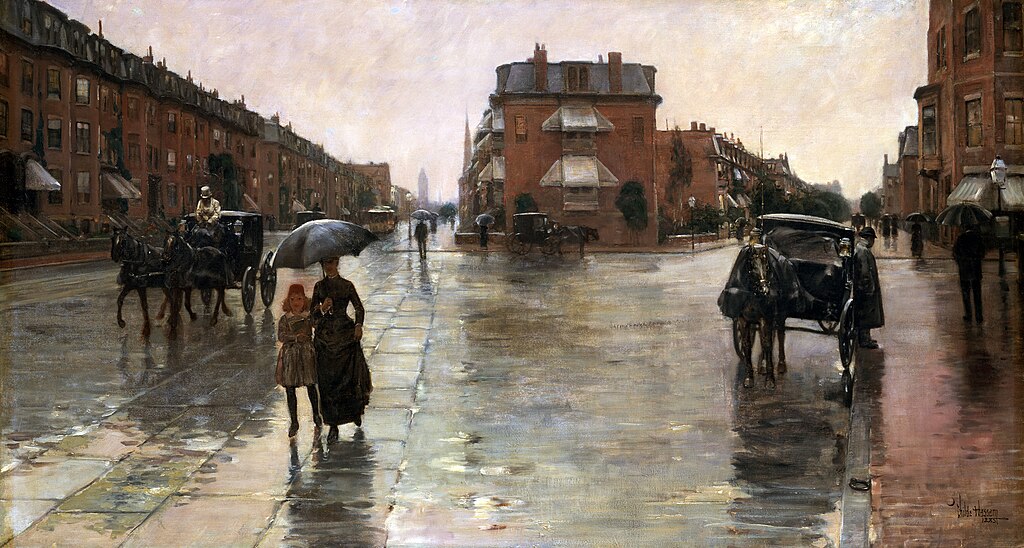
Childe Hassam: The Golden Ratio of Info & Emotion
"Analyzing Rainy Day, Boston (1885) through the AEF Logic Scope"
Childe Hassam (1859–1935) was one of the leading figures of American Impressionism. His career bridged the late 19th century’s Realist traditions and the emerging Impressionist movement, making him a crucial transitional artist. Hassam’s subjects often included urban streets, domestic interiors, and patriotic themes, but his hallmark was the ability to transform ordinary environments into lyrical experiences of light and atmosphere. His brushwork evolved from precise realism to broken, shimmering strokes, reflecting the Impressionist fascination with perception and fleeting sensation.
Rainy Day, Boston (1885) is a boundary painting: it retains the structural clarity of Realism while experimenting with Impressionist techniques. This equilibrium allows viewers to trust the recognizable cityscape while simultaneously experiencing emotional resonance through blurred reflections and atmospheric effects.
🎨 AEF Analysis: The Aesthetics of Equilibrium
1. Visual Resonance: Cognitive Stability & Variation
The realist framework provides "secure information", while impressionistic touches provide "emotional stimulation."
- 🔹 Realist Anchor (Information): Linear perspective allows the brain to immediately grasp the space as a recognizable physical world.
- 🔹 Impressionist Flow (Emotion): Light reflecting off rain-soaked asphalt blurs boundaries, inviting viewers to project personal memories into the gaps.
2. Sensory Transfer: Visualization of White Noise
This work possesses a synesthetic scope that stimulates smell and hearing through sight.
- 🔹 Auditory Flow: Grayscale gradations summon “white noise” (rain sounds), erasing daily distractions and activating the parasympathetic nervous system.
- 🔹 Thermal Response: Hassam conveys cool freshness, inducing serotonergic stability through subtle temperature differences.
3. Emotional Balancing: "Safe Solitude"
Hassam maintains a safe distance—neither too dry (Realism) nor too chaotic (Impressionism).
The carriages and pedestrians fading into mist grant the freedom of anonymity, allowing social beings to escape the gaze of others and focus inward.
Art-Historical Significance
Hassam’s art-historical importance lies in his ability to adapt Impressionism to American contexts. While French Impressionists often painted leisure in gardens or cafés, Hassam applied the style to bustling city streets and patriotic parades. His “Flag Series” during World War I exemplified how Impressionist brushwork could carry national symbolism. Yet his earlier works, like Rainy Day, Boston, show the delicate negotiation between Realist clarity and Impressionist atmosphere. This transitional quality makes the painting a key document of stylistic evolution.
His technique combined broken brushstrokes, attention to atmospheric conditions, and a lyrical approach to light. Themes of urban modernity, weather, and anonymity recur throughout his oeuvre, reflecting both the dynamism and alienation of city life. Hassam’s paintings thus serve as cultural mirrors, capturing the psychological rhythms of modern existence.
🛠️ AEF Logic Scope Summary
| Category | Realist (Information) | Impressionist (Emotion) | AEF Result |
|---|---|---|---|
| Function | Cognitive Trust | Emotional Empathy | Cognitive Fluency |
| Neural System | Frontal Lobe | Limbic System | Balanced Recovery |